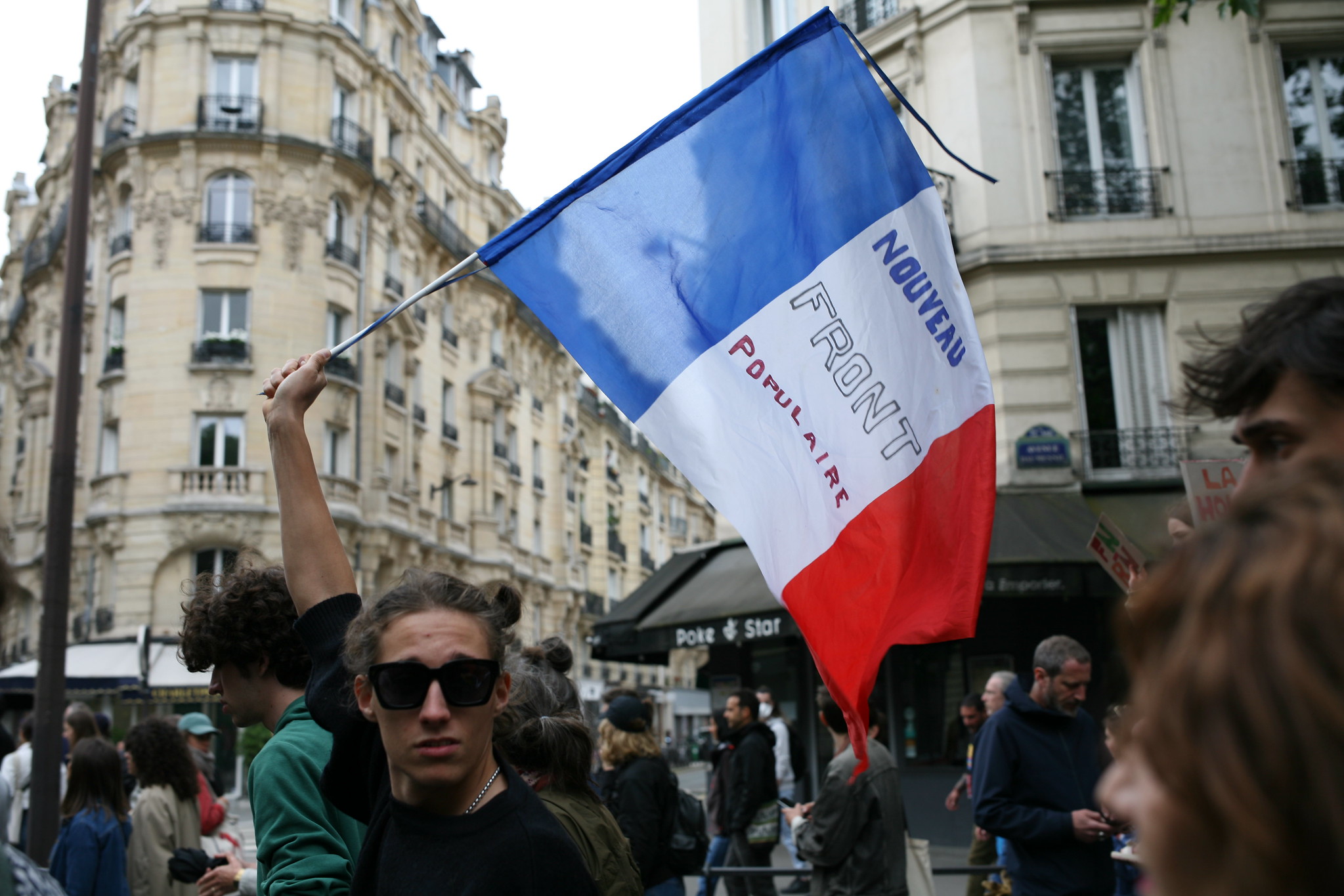
The world’s most childish political left

By refusing to accept that Emmanuel Macron has chosen a prime minister from the political right rather than someone from among them, the French political left is about to make a grave mistake. It is set to impose a ban on Michel Barnier from day one, but not only will this ban not bring him down – because the left does not have a majority –, not only will this defiance not work to the left’s advantage, but it will complete the process of turning the far right into a full-fledged player on the political scene.

Much more skillfully than the left, the “Lepenists” of the National Rally have preferred to “judge by evidence”. They will wait, they say, to see if the policies of the future Barnier government meet their “demands”. They will, they say, “keep an eye on it” and in this way they will become indispensable.

At any moment they choose, they can announce that they want to ban this government, and then the left will find itself in an impossible situation. Either it would have to disgrace itself by voting with the extreme right against a right-wing but perfectly democratic prime minister, or it would have to save Michel Barnier’s neck by going against the no-confidence vote it will have wasted on him.

In both cases, consistency will be on the side of the National Rally and not on the side of the left. In either case, the far right will be able to pose at the 2027 presidential elections as a moderate force that, unlike the left, has played for stability but can no longer support a right wing that it will say is incapable of fighting immigration and the high cost of living.

With this sulky child posture, the left is thinking with its feet. They must not make this mistake. The left must not vote for this nonsensical ban. The left must see reason, but at the moment it is all in a rage because, as it chanted in the streets on Saturday, it was the left that should have formed the government, the left that came out on top in the snap legislative elections this summer, and not Michel Barnier, a member of a party, “Les Républicains”, that the voters relegated to the very last place in those elections.

This is true. There is a “democratic anomaly”, as the more moderate say, but the left is wrong, totally wrong to complain because it is in fact them who are to blame for this situation and no one else.

While the voters had divided the National Assembly into three main blocs – the united left of the New Popular Front, the centrist parties on which Emmanuel Macron relies, and finally the “Lepenists” of the National Rally – the left behaved as if it had a parliamentary majority of its own.

Strangely, the left confused a relative majority with an absolute majority, and that is not all. It also allowed its most radical component, La France Insoumise, the “France Unbowed” to declare that it intended to put forward “its entire programme”, even though this common programme, hastily adopted in order to present a united front against the extreme right, was considered completely unrealistic by the centre and the right, which did not want it.

Instead of seeking the allies that would have enabled it to take the reins of the majority coalition, the French left cut itself off from all the democratic forces with which it could have formed a united government. Instead of defining the priority measures which it would have had the merit to push forward, it wasted weeks trying to find a common candidate for prime minister, a complete unknown, closer to the “Insoumis” than to social democracy, who it was clear would not win a majority in the National Assembly.

It would therefore have been surprising if the President of the Republic had not rejected her, whether out of disagreement with her programme or because Michel Barnier was more likely to win a majority than she was. It may well have been for both reasons, but the fact is that it is the head of state and not the political parties, even if they are in the lead, that the Constitution entrusts with the task of appointing the head of government.

So, Emmanuel Macron did not commit a “coup d’état”. Nor is it true that he never wanted a left-wing prime minister. I will be able to testify to this when the time comes, but the situation that has arisen is obviously not good. It is even worrying, and instead of making useless accusations, the left would do better to reach an agreement with Michel Barnier on common objectives, so that it is they and not the Lepenists who put the Prime Minister “under surveillance”. They could still do it. It could still turn the situation around, but only if it stops aspiring to the title of the world’s most childish political left.

(Photo credit: Jeanne Menjoulet, flickr.com/photos/jmenj/)

France is not dead yet

I am now thinking that maybe this gamble was not so crazy. I say this cautiously, without totally believing it because, since the announcement of the dissolution of the National Assembly, I have been through all the stages. First of all, I thought and said publicly, in the heat of the moment, that we should indeed, yes, absolutely, ask the country whether the 40% or so of the vote that went to the extreme right was only an expression of anger or of a real desire to bring the Lepenists to power. I was convinced that we had to go through this moment of truth, because in my view it was impossible for 4 out of 10 French people to have swung to the extreme right, but the next day, Monday morning…

What a hangover! There was not a radio station or TV news programme that wasn’t already debating the conditions under which the Rassemblement National would be able to govern and the reasons that had led the President to commit such a folly. I could already see them, these professional liars, these demagogues, these public dangers, entering the ministries and announcing very quickly that they were going back on their promises, cutting social welfare, slashing the European budget and blocking aid to Ukraine.

I could see Trump and Putin smile with delight, as the Union was unravelling at the very time when it needed a common Defence and industrial policies, and the paper I had sent to Libération seemed, on re-reading, frankly absurd. I had entitled it “How not to become a Lepénist”. I set out the three conditions under which we could avoid such a disastrous fate, but all my reasoning now seemed wrong, because just by the speed at which the unthinkable was entering the conversations, I understood that everything was ruined. In 48 hours I had been back and forth 48 times, but in the last few days… what can I put it?

Let us take the facts and describe them. Whatever was left of the once Gaullist right wing – not nothing but not much – has exploded. In statements whose vigour did credit to their political family, virtually all the elected representatives, leaders and major figures of the right condemned the electoral agreement that the president of their party had just concluded with the far right.

It was “no, no, and no!” and those 99% of the right who had not already joined the Macron caucus thus found themselves on the fringes of that great moderate, European and increasingly Keynesian centre to which they are in fact so close. So why shouldn’t they one day come to accept the idea, advocated on Wednesday by Emmanuel Macron, of a “federation” of social democrats, the centre, the right and the ecologists?

Obviously, there will be no agreement between the right and Macron before the elections. Like the left, the right will want to defend its identity at the ballot box, but once the results are in, everything could well change. If the Lepénistes win an absolute majority, the right, the left and the Macronie will find themselves together in opposition to the far right and in support, de facto at least, of Emmanuel Macron, who remains President and uses all his constitutional powers against it. If, on the other hand, the Lepenists do not win enough seats to govern, the possibility of a rapprochement between a large part of the right and the Macronist centre will become strong, even very strong.

On the right, this dissolution has already brought about many changes, but on the left?

The dissolution has resuscitated the left. The repulsion that the mere prospect of a far-right government inspires in the Socialists, the Insoumis of the radical left, the ecologists and the Communists’ ranks is such that it did not take them two days to agree on the need to reach an agreement. Despite the substantial differences between these four currents, there is a strong unitary dynamic on the left, the advantage of which is to mobilise its voters, every single one of them, in the fight against the Lepénistes.

The left is not yet in a position to obtain an absolute majority, but it could contribute to closing the doors of power to the Rassemblement National and would then have to choose between paralysis of the Assembly and a form of rapprochement with the centre and the right. Faced with this alternative, it is not impossible that the left will divide as deeply as the right has just done and that its more moderate components will agree to support some of the initiatives of the centre and the right or even join them in a unity government.

We do not know, but on both the left and the right, this dissolution has reopened the field of possibilities at a time when the humiliating defeat of the presidential camp in the European elections had added to the unpopularity of Emmanuel Macron, who had already been governing for two years without a parliamentary majority. France was condemned to a mortifying stalemate that would lead to further gains for the far right, but this dramatic turn of events turned the tables and forced everyone to make immediate and radical changes. More than politics, it is prestidigitation, but there was probably nothing better to do and… who knows?